01Overview
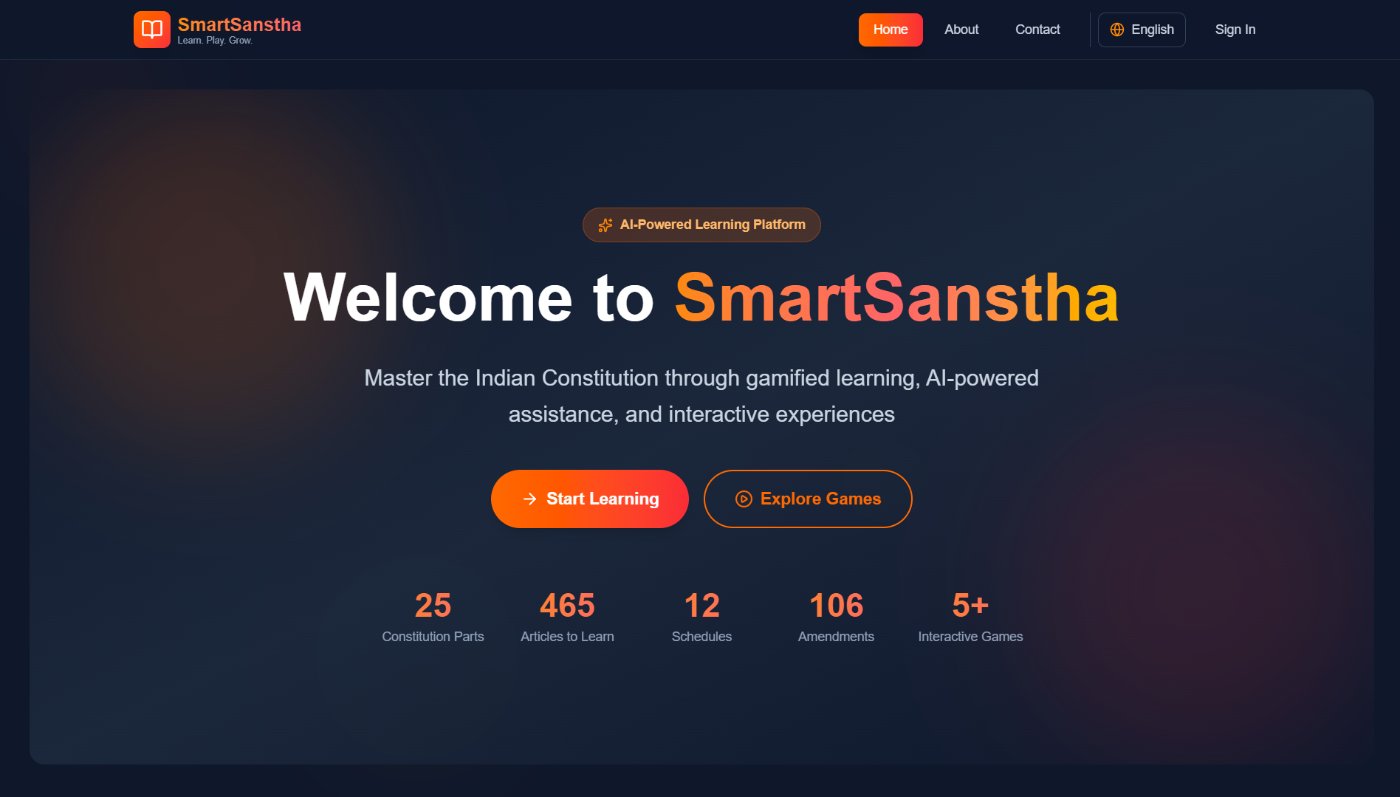
SmartSanstha makes the Indian Constitution easier to understand, explore, and engage with.
The problem wasn't a lack of information — it was a lack of accessibility, clarity, and motivation. My role was to transform a dense legal subject into an experience that feels modern, interactive, and less intimidating.
02Problem
People don't avoid the Constitution because it lacks importance. They avoid it because learning it has been designed badly.
📖 Dense legal language
The original material feels difficult and inaccessible — especially for students and first-time learners.
😴 Low engagement
Traditional educational formats create passive learning instead of active curiosity.
🌐 Accessibility gaps
Many existing resources fail to support mobile-first, multilingual, or low-literacy use.
❓ Weak real-world context
Users don't understand how constitutional concepts connect to daily life and citizenship.
03Product Strategy
Simplify learning
Break complex content into smaller, more understandable learning units.
Increase engagement
Use gamification and simulations to encourage curiosity and repeat usage.
Make it practical
Connect constitutional learning to real-life scenarios and user questions.
Design for inclusion
Ensure accessibility, readability, and support for broader audiences.
04Core Features
Constitutional Games
Mini-games that turn article-based learning into an active experience.
Courtroom Simulation
Scenario-based interaction that engages users with constitutional reasoning.
AI Constitution Chatbot
A conversational layer answering constitutional questions in simpler language.
Adaptive Quizzes
Quiz difficulty evolves with the learner's progress and confidence.
User Dashboard
A progress system with XP, streaks, achievements, and learning summaries.
Article Library
A cleaner, more understandable way to browse constitutional content.
05My Contribution
Information architecture — structured the platform so modules, games, quizzes, and articles feel connected, not fragmented.
Onboarding design — a flow that personalises the learning path based on interest level and goals.
Gamification UI — the visual system for XP, streaks, badges, and progress motivation.
Courtroom simulation UI — one of the most complex screens — balancing debate flow, references, and interaction clarity.
Accessibility & design system — contrast, type hierarchy, reusable components, and a scalable UI language.
06Impact
This project pushed me beyond interface design into real product thinking — designing not just for beauty, but for education, behaviour, and social relevance.
07What I Learned
Complex subjects need emotional design
If a subject feels intimidating, good UX has to reduce that intimidation before learning can even begin.
Good structure is invisible power
Strong information architecture makes a complicated platform feel natural, even when the content is dense.